
Women’s business coaches: Why they matter and who is making an impact
Women’s business coaches: Why they matter and who is making an impact
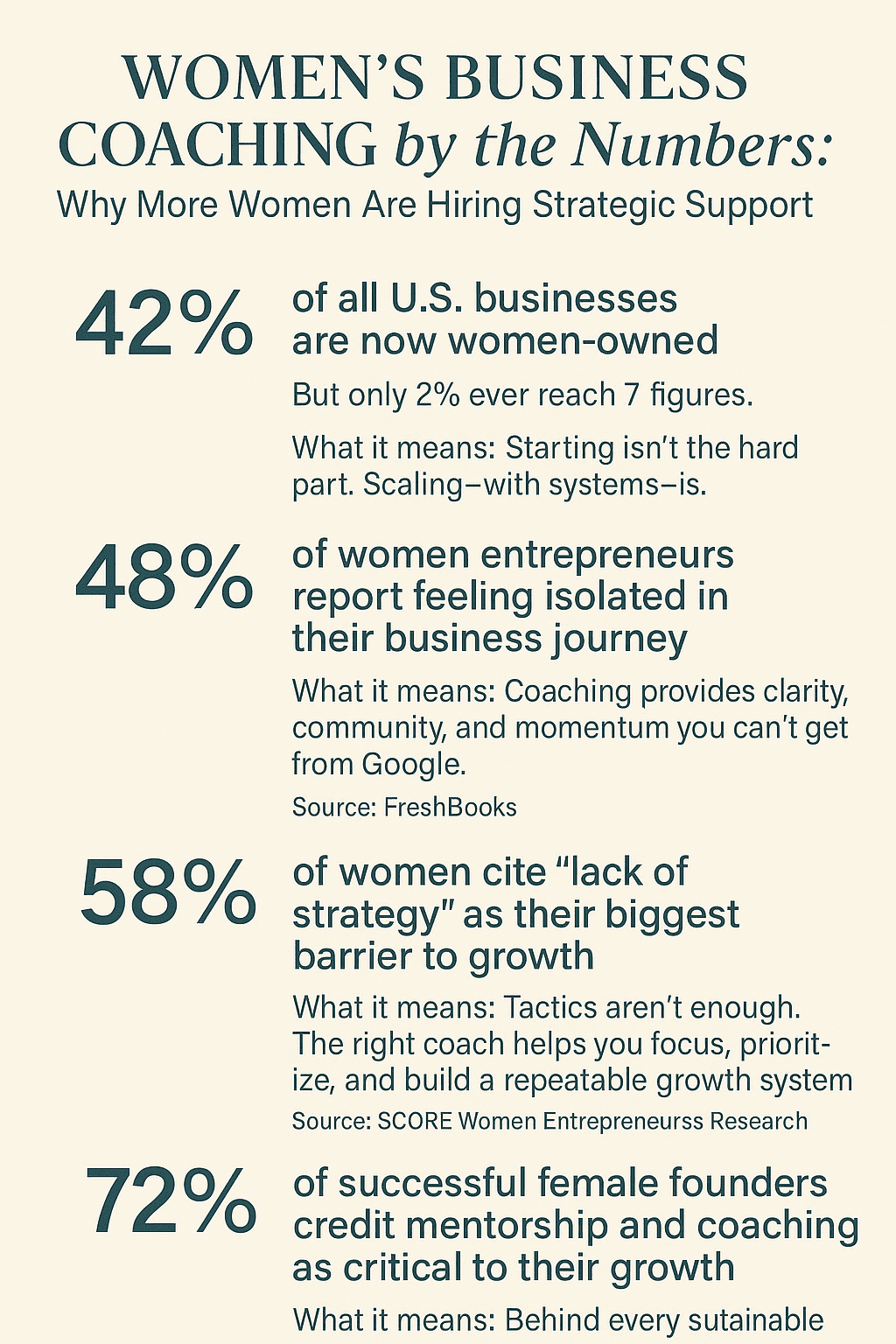
Women’s business coaches can understand parts of entrepreneurship that are easy to dismiss when you have never carried them. The client who builds sales calls around school pickup. The veteran who can lead a team through chaos but has never been taught how to price her expertise. The consultant who is praised for being accommodating while unpaid revisions destroy her margin. The founder whose income is treated like optional household money even though her company is paying real bills.
That context matters. It can make the coaching room more honest and shorten the distance between what a client says and what is actually happening.
It is not enough.
A shared identity does not prove that a coach can diagnose an offer, read a pipeline, understand delivery capacity, or help a founder make a decision she has been avoiding. A woman can feel deeply seen and still leave every call with a business that depends on her memory, availability, and willingness to work late.
The standard has to be higher than “she gets me.” The work should change how the business operates.
The founder did not need another person telling her to be visible
Consider Monique, a composite example built from patterns common in small service businesses. She runs an HR consulting company and works primarily with professional service firms. She earned $132,000 last year. From the outside, the business looked established. She had clients, referrals, a polished website, and years of experience.
Inside the company, Monique was carrying the whole operation. She wrote every proposal, led every engagement, answered every client email, managed the contractor, created every presentation, and handled every sales follow-up she remembered to send. Her calendar was full, but her cash position was unpredictable because projects were billed in stages and clients regularly delayed approvals.
When revenue slowed, she blamed visibility. She bought a coaching program that asked her to post daily, tell more personal stories, and increase engagement. She followed the plan. Her audience grew. Her workload grew with it. Revenue did not become more reliable.
The content created conversations, but the company had no defined way to move those conversations toward a decision. Warm prospects sat in direct messages. Referral introductions received enthusiastic replies and no next step. Discovery calls ended with custom proposals that took three hours to write. Monique was not invisible. She was leaking qualified interest between attention and sales.
A useful business coach would not hand her another content calendar. She would trace what happened after a potential buyer raised a hand.
Women’s business coaches have to separate the symptom from the constraint
Monique had generated thirty-two credible inquiries in six months. Twenty-one turned into sales conversations. She sent thirteen proposals. Three clients signed.
Those numbers tell a different story from “I need more leads.” Nearly two-thirds of the inquiries became conversations. The larger drop happened after the conversation. Only three of thirteen proposals closed, and six proposals never received a direct no. They simply disappeared.
The coach’s first responsibility was to understand why. Were the wrong people reaching the call? Was the problem urgent enough to fund? Did the buyer have authority? Was Monique explaining the work before understanding the business impact? Did the proposal create clarity or bury the decision under options? Was there a defined follow-up date?
They reviewed five recorded calls and the proposals connected to them. Monique was spending most of each call proving her expertise. She described assessments, interviews, workshops, reports, and support. She asked very little about the cost of the client’s current problem. She also sent proposals to people who needed another executive’s approval without inviting that executive into the process.
The issue was not confidence. Monique was confident in her work. The issue was that her sales process made her responsible for presenting a solution before the company had established who would decide, what the problem was costing, and whether the organization was ready to act.
The coaching conversation had to produce a business decision
Monique and her coach changed the sales process before changing the marketing plan. Discovery calls stopped being free consulting sessions. The conversation began with the operating problem. Where was the HR issue appearing? What was it costing in turnover, manager time, missed work, risk, or delayed growth? What had already been attempted? Who owned the decision? What would happen if the company did nothing for another six months?
Monique did not use those questions to manufacture pain. She used them to determine whether the engagement was necessary, fundable, and appropriate. When the fit was weak, she said so. When another leader needed to participate, the proposal waited until that conversation happened.
The proposal itself became shorter. It named the condition the company wanted to change, the result Monique would help create, the boundaries of the engagement, the client’s responsibilities, the investment, and the decision date. Her process was explained only as far as the buyer needed to understand how the result would be produced.
During the next quarter, Monique held twelve qualified sales conversations and sent seven proposals. Four signed. The close rate on proposals moved from 23 percent to 57 percent. At an average project value of $12,000, those four clients represented $48,000 in booked work.
This is a composite example, not a promise of results. The point is the sequence. More visibility would have sent additional prospects into a weak decision process. Repairing the sales system allowed the existing demand to produce more business.
Being understood should make the analysis sharper
Monique had another problem she had not named. She overdelivered because she believed a good service provider should make the client’s life easier. When a client missed a deadline, Monique absorbed the delay. When a manager requested an extra review, she added it. When the project sponsor wanted a new training session, she found room.
Those choices looked generous one at a time. Together, they turned a forty-hour engagement into sixty-five hours. At $12,000, the expected revenue per delivery hour was $300. At sixty-five hours, it dropped to about $185 before expenses, taxes, sales time, and administration.
A coach who understands the expectations placed on women in service businesses can recognize why “just set boundaries” is incomplete advice. Monique was not failing to know that boundaries existed. She was making a commercial promise that the offer itself did not support. The scope was loose, the client responsibilities were vague, and there was no process for pricing additional work.
They rewrote the engagement around specific deliverables and decision points. Client delays moved the timeline. Additional workshops required a change order. Communication had a response standard. Monique still cared deeply about her clients. She stopped making unpriced labor the evidence of that care.
That is where identity-aware coaching earns its value. It can name the pressure without using the pressure as an excuse. It can help a woman see that warmth and standards belong in the same business.
A coach should make the founder less dependent on coaching
Monique did not need her coach to approve every proposal or write every boundary email. She needed a way to make those decisions after the engagement ended.
They established decision criteria. A prospect was qualified when the company had a defined problem Monique solved, a reason to act, access to the decision-maker, the capacity to participate, and a budget aligned with the work. A request was outside scope when it changed the promised deliverable, required additional preparation, added stakeholders, or extended support beyond the agreement.
They also built a weekly review around the movement of real business. Monique looked at qualified conversations, next actions, proposals, booked revenue, outstanding invoices, delivery hours, and client risks. The review did not exist to create a dashboard. It existed to expose the decision she needed to make while there was still time to make it.
After several months, Monique could see a slow pipeline before it became a revenue emergency. She could see an expanding project before it damaged the margin. She could see when the company had room for a new client and when selling more would overload delivery.
The coach had helped build judgment and infrastructure. She had not made herself indispensable.
The wrong kind of support can keep a capable woman busy
Some coaching relationships continue because the client always has more tactics to implement. Every month introduces another platform, funnel, offer, launch, script, or visibility challenge. The founder remains active, but the business never develops a stable way to acquire and serve clients.
Activity can feel especially convincing to women who have been rewarded for being reliable. Completing the assignment feels like progress. Following the system feels responsible. The harder question is whether the assignment changes the constraint.
If the problem is an offer that loses money, a new social platform is a distraction. If qualified prospects already exist, another lead magnet may be avoidance. If every client requires the founder, scaling demand before fixing delivery is dangerous. If the founder cannot explain where revenue comes from, a larger audience will not create control.
A women’s business coach should be willing to say, “That is not the mission right now.” She should also be willing to say when the client needs an accountant, attorney, therapist, clinician, technical specialist, or another qualified professional instead of coaching.
What meaningful support changes
At the end of the work, Monique still had challenges. Businesses do not graduate from problems. The difference was that she was no longer responding to every problem with more personal effort.
She had a sales process that qualified decisions before proposals were written. She had an offer with scope and change control. She had numbers that connected marketing, sales, revenue, and capacity. She had language for direct client conversations. Most important, she could see the company as a system instead of treating every weak result as evidence that she needed to work harder.
That is the impact worth looking for when choosing among women’s business coaches. Shared experience can create trust. Warmth can make hard conversations possible. Neither replaces competence. The coach should be able to follow the money, understand the operating model, challenge the founder without diminishing her, and turn insight into a business practice that remains after the call.
Start with the business you actually have
Before hiring a coach, look at the last ninety days. Identify where your qualified prospects stopped moving, which offer consumed the most founder time, which client requests expanded without additional payment, and which part of the company stopped when you became busy.
Do not ask only whether a coach understands women like you. Ask whether she can help you understand the business in front of you.
The 9-Line Business Roadmap™ helps reveal how a problem in one line creates pressure in another. If you want a second set of eyes on what the numbers and workload are telling you, book a clarity call. We will diagnose the problem first. If my offer is not the right next step, I will tell you.