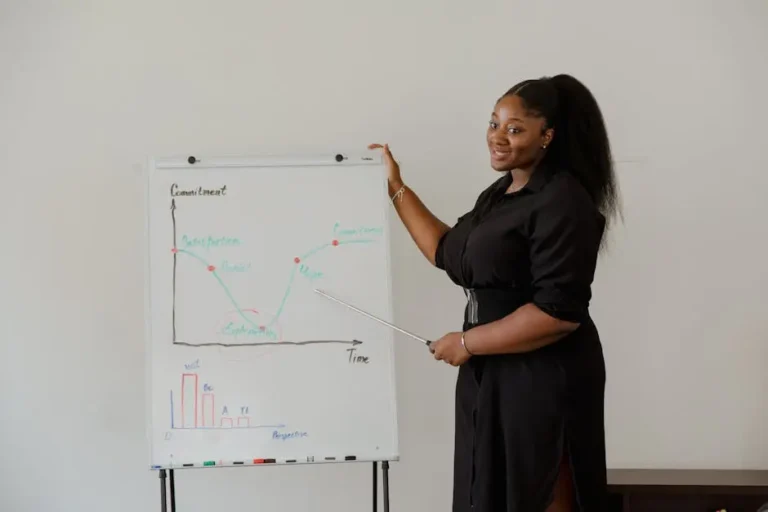
What a female business coach really does
What a female business coach really does

A female business coach should do more than encourage you, hand you assignments, or repeat advice you could find in a podcast. The real work is helping you see the business clearly, make stronger decisions, and build the operating system that turns those decisions into consistent action.
For a woman coach or service provider, that often means working inside a business where the founder is still carrying marketing, sales, delivery, administration, and leadership at the same time. Every new tactic competes with client work. Every unclear decision returns as another task. The coach has to understand that reality before prescribing growth.
The best coaching does not create dependence on the coach. It strengthens the owner’s judgment, exposes the constraint, and leaves behind a business that knows what happens next.
She helps you separate the symptom from the constraint
Most owners arrive with a visible problem. They need more clients, better content, a stronger offer, higher prices, or more time. Those problems are real, but they are not always the root cause.
A coach looks across the business before deciding what to fix. Weak sales may begin with the wrong audience, unclear positioning, poor qualification, inconsistent follow-up, or an offer that asks for too much commitment too early. An empty pipeline may not be a content problem at all. The owner may stop marketing every time delivery gets busy.
The coach’s job is to find the constraint closest to revenue and client experience. That protects the owner from spending another quarter solving the loudest problem instead of the most expensive one.
She turns the revenue goal into business math
A revenue target is not a strategy until it is translated into clients, price, conversion, conversations, delivery hours, expenses, and capacity. A strong coach helps the owner work backward from the goal and see whether the current model can support it.
If a coach wants to reach $180,000 with a $3,000 offer, she needs sixty clients before accounting for renewals or other revenue. If each client requires twenty-five delivery hours, the model creates 1,500 hours of fulfillment. Add marketing, sales, administration, and time off, and the target may be mathematically possible but operationally reckless.
That analysis changes the coaching conversation. The answer may be a clearer scope, stronger price, longer engagement, smaller client volume, or a second offer that solves a different level of problem. The coach does not demand more stamina from a broken model. She helps redesign the model.
She protects the CEO role from the daily workload
In a small business, the founder moves between three jobs. She produces the work clients bought. She operates the systems, schedule, money, and administration. She also has to lead the company by setting priorities, creating demand, reviewing performance, and making decisions about risk and capacity.
The producer and operator roles are loud. Client deadlines arrive. Emails need answers. A broken form demands attention. CEO work is easier to postpone because the cost does not appear immediately.
A female business coach protects time for leadership and makes that time concrete. Instead of telling the owner to “work on the business,” she connects the calendar to the current mission. A weekly block might be assigned to pipeline review, relationship-building, offer decisions, financial review, or documenting a delivery process. The time has a job.
She narrows the mission before adding tactics
Women entrepreneurs are often carrying too many reasonable ideas. A new workshop could work. So could a podcast, community, certification, lead magnet, partnership, and second offer. The issue is not whether each idea has potential. The issue is what the business can execute without abandoning the work already responsible for revenue.
A coach forces the tradeoff into the open. She asks whether the idea solves the current constraint, serves the established buyer, fits the model, and deserves resources now. If the answer is no, the idea is parked without being treated as a failure.
This is where accountability becomes useful. It is not task policing. It protects the agreed decision long enough to produce evidence. The coach helps the owner stop replacing a difficult priority with a more exciting project.
She builds a client-acquisition system the owner can sustain
Client acquisition cannot depend on panic. If the owner starts marketing only when revenue drops, every slow month becomes an emergency. The coach helps create a small, repeatable route from visibility to conversation.
That route begins with a defined buyer and a clear problem. Content teaches the buyer how to understand the problem and evaluate the next decision. Relationship-building creates human conversations. A useful resource or article deepens trust. The CRM preserves context. Follow-up continues until there is a fit, a no, or a better time.
The system does not need six channels. It needs enough consistent activity to create qualified conversations at the rate required by the revenue plan. A good coach helps the owner choose what she can maintain during a full client week, not what looks impressive on a planning board.
She strengthens the sales conversation without turning it into pressure
Sales coaching should improve diagnosis, qualification, and decision support. It should not teach the owner to force urgency onto someone who is not ready or not suited to the offer.
The coach reviews how prospects enter, what information is gathered, how the call is structured, where objections appear, and what follow-up occurs. She helps the owner explain the problem, outcome, process, scope, investment, and next step in plain language.
She also looks for patterns. If many qualified prospects hesitate at the same point, the issue may sit upstream in positioning or expectations. If calls are filled with people who cannot use the offer, the qualification path needs repair. The goal is not a perfect closing script. It is a sales process that makes the right decision easier for both people.
She connects growth to delivery capacity
More clients are not automatically good news. Growth can damage trust when onboarding breaks, deadlines slip, or the founder becomes unavailable to the people who already paid.
A business coach examines the work after the sale. She looks at scope, milestones, communication, scheduling, support boundaries, quality standards, renewals, and the founder’s delivery hours. She helps the owner decide what must remain personal, what can be standardized, and what can be delegated safely.
Delegation comes after clarity. Handing a messy process to a contractor adds management without removing confusion. The coach helps define the outcome, steps, decision points, owner, and quality standard before another person is expected to carry it.
She uses numbers to improve decisions, not judge the owner
A coach needs evidence. That does not require a complicated dashboard. It requires a baseline and a small set of numbers tied to the current mission.
For client acquisition, that may include qualified leads, conversations, show rate, offers, conversion, source, and time to follow-up. For delivery, it may include client load, hours, margin, milestones, retention, and capacity. For the founder, it may include hours spent producing, operating, and leading.
The numbers are a sitrep. They show where people move, where they stop, and whether the chosen repair worked. A good coach uses that information to challenge assumptions without turning the session into a performance review.
She sees the realities women bring into the business
A female business coach should not assume every woman shares the same experience. She should understand that credibility, caregiving, risk, visibility, access to capital, military transition, health, and family responsibility can shape how a business is built.
That context does not lower the commercial standard. It improves the strategy. Advice is stronger when it accounts for the owner’s actual constraints, resources, responsibilities, and ambition instead of forcing her into a model designed for someone else’s life.
The coach should be able to hold both realities at once. The business needs honest math and disciplined decisions. The owner also deserves support that does not shame her for having a body, family, history, or capacity limit.
What should be different after 90 days
After ninety days of useful coaching, the owner should be able to explain the business more clearly. She should know the buyer, the offer, the revenue math, the current constraint, the few priorities that matter, and the numbers that show movement.
Her calendar should reflect the strategy. Follow-up should not depend on memory. Client delivery should have clearer boundaries and ownership. New ideas should be evaluated against the mission instead of becoming immediate commitments.
The business will not be finished. It will be more operable. That is the standard. Coaching should leave behind decisions, systems, and judgment the owner can keep using when the coach is not in the room.
How to choose the right female business coach
Ask how the coach diagnoses a business before recommending tactics. Ask what information she needs, how priorities are chosen, and how progress is measured. Ask what the business will be able to do after the engagement that it cannot do now.
Listen for specificity. A strong answer connects positioning, offers, pipeline, sales, delivery, capacity, and money. Be cautious when the solution appears before the coach understands the problem, or when every client is pushed toward the same content plan, funnel, or offer model.
The relationship should include challenge, warmth, and clear expectations. You need a coach who will tell you when the plan and calendar do not match, and who will help you make the next move without making you feel small.
The goal is a business that does not depend on heroics
What a female business coach really does is help the owner replace reaction with leadership. She brings the whole business into view, protects the priority, strengthens the decision, and installs enough structure for execution to continue after the session ends.
You do not need more motivation layered onto an overloaded operation. You need a business model, client-acquisition path, and delivery system that respect the mission and the person carrying it.
The 9-Line Business Roadmap™ helps you see where the business is breaking before you add another tactic. If you want a second set of eyes on the constraint, book a clarity call. We will diagnose first and discuss support only if it fits.