
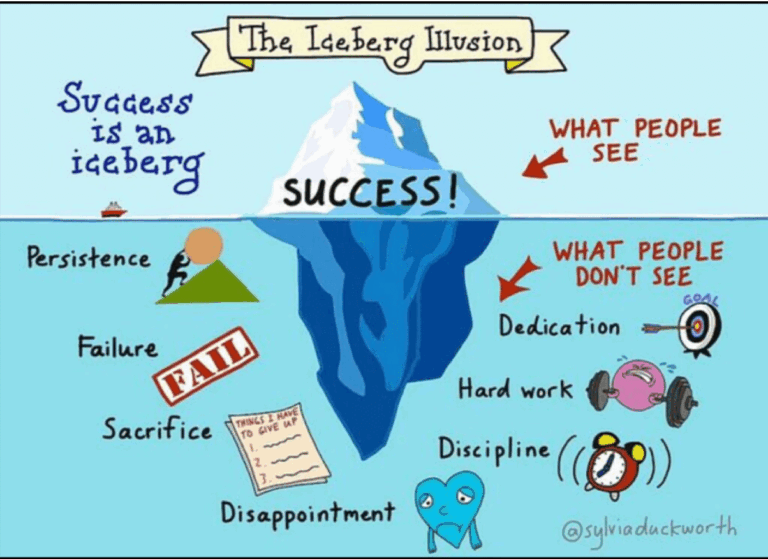
The iceberg illusion in business hides the infrastructure beneath success
The iceberg illusion in business is the mistake of comparing someone else’s visible result with none of the infrastructure beneath it. You see the launch, revenue announcement, booked calendar, polished website, or growing team. You do not see the years of decisions, systems, follow-up, failed experiments, documentation, and capacity planning that made the result possible.
This is not a lesson about working harder. It is a reminder to build the operating system beneath the outcome.
What Customers See Above the Surface
A clear offer; Consistent content; A smooth sales conversation; Confident delivery; A recognizable brand; Reliable growth.
Those results matter. They are still the visible outputs of less visible work.
The Positioning and Offer Work Below
A strong offer rests on decisions about the ideal client, problem, scope, process, pricing, proof, boundaries, and fit. The clean sentence on a sales page may represent weeks of interviews, lost deals, client feedback, and revisions.
When an offer is difficult to sell, inspect those decisions before blaming the audience or adding more content.
The Marketing System Below
Consistent visibility depends on:
A documented message; A content plan tied to the client journey; Templates and production workflows; Distribution and engagement routines; A landing page and lead-capture path; Email nurture and sales follow-up.
The iceberg illusion in business makes that infrastructure look like “she is naturally good at marketing.” In reality, repeatable visibility is built.
The Sales Infrastructure Below
A smooth sales process requires qualification standards, call notes, proposal templates, objection tracking, CRM stages, decision dates, follow-up tasks, and a respectful close-the-loop process.
The buyer sees one conversation. The business needs a system that makes the next action visible.
The Delivery System Below
Reliable delivery depends on onboarding, communication expectations, project stages, client responsibilities, templates, quality checks, offboarding, and retention.
A brand promise is credible when the operating experience supports it.
The Capacity Decisions Below
Growth requires decisions about what the founder owns, what can be automated, what needs documentation, what should be delegated, and what should stop.
Adding demand to weak infrastructure does not create sustainable growth. It exposes the weak handoffs faster.
Use the Iceberg Illusion in Business as an Audit
- Name the visible result you want.
- List the decisions and systems required beneath it.
- Mark what exists, what is inconsistent, and what is missing.
- Choose the weakest handoff with the greatest effect.
- Document the process and owner.
- Measure whether the system produces the intended result.
Do not copy someone’s visible tactic without understanding the business conditions supporting it.
Final Word: Build Below the Surface
The iceberg illusion in business hides the infrastructure beneath a visible result. Stop judging your business by another company’s highlight reel. Diagnose the system. Build the missing handoff. Repeat the process until the result is supported by something you can operate.
Need help mapping the systems beneath your next stage of growth? Book a Clarity Call or explore our services.
Illustration source: Sheridan Library and Learning Services.
Put iceberg illusion in business to work
Turn the strategy into an operating decision. Start with the real constraint, connect the work to the client journey, and make ownership visible.
Set one measurable objective; Choose the current constraint; Assign owners and deadlines; Review evidence before adding tactics.
Measure business movement
Record the baseline before changing the system. Review qualified leads, sales conversations, conversion, revenue, delivery capacity, and owner time. Keep what improves the right number. Repair the handoff when it does not.
Use the 9-Line Business Roadmap™ to identify the missing decision. If you want help diagnosing it, book a clarity call. We will discuss support only if it fits.